

FITIV Pulse turns your overnight HRV, resting heart rate, and sleep into two daily numbers: a Recovery score each morning, and a Training Readiness score that tells you when to push and when to pull back. Recovery deserves that attention because a workout is only the stimulus. Your body adapts in the hours and days afterward, as it repairs and rebuilds, so training hard every day without enough recovery piles up fatigue without the fitness to show for it.
What is a Training Readiness Score?
A training readiness score is a daily number that estimates how well you've recovered from previous training and how ready you are to take on more. Because it combines several physiological signals instead of one (heart rate alone, or sleep duration alone), it gives you a more complete picture of your recovery.
FITIV builds this in two layers.
1. Recovery score (0–100), calculated when you wake up. It compares last night's vitals and sleep to your own typical range:
- Heart rate variability (HRV): higher HRV suggests effective recovery; lower HRV can indicate fatigue or stress
- Resting heart rate: a lower resting HR typically reflects better recovery
- Sleep: how well you met your sleep needs, based on your Sleep score
- Respiratory rate, blood oxygen, and wrist temperature: stable, typical values support recovery, while a higher-than-usual respiratory rate, a dip in blood oxygen, or a raised wrist temperature can pull your score down
A Recovery score above 50 means you're above your typical baseline. FITIV groups Recovery into three levels: Excellent (67 and above), Normal (34–66), and Low (33 and below), where extra rest may be needed.
2. Training Readiness (0–100), which updates through the day. It starts from your overnight recovery (poor recovery reduces readiness) and then accounts for what your body is carrying:
- Recent strain and workouts: your activity from the past few days, with recent efforts counting more. High strain may lower readiness
- Battery: low energy reserves reduce readiness
- Training load ratio: your recent workload compared with your long-term fitness trend. A well-balanced load supports higher readiness, while a sharp spike lowers it
Training Readiness Levels
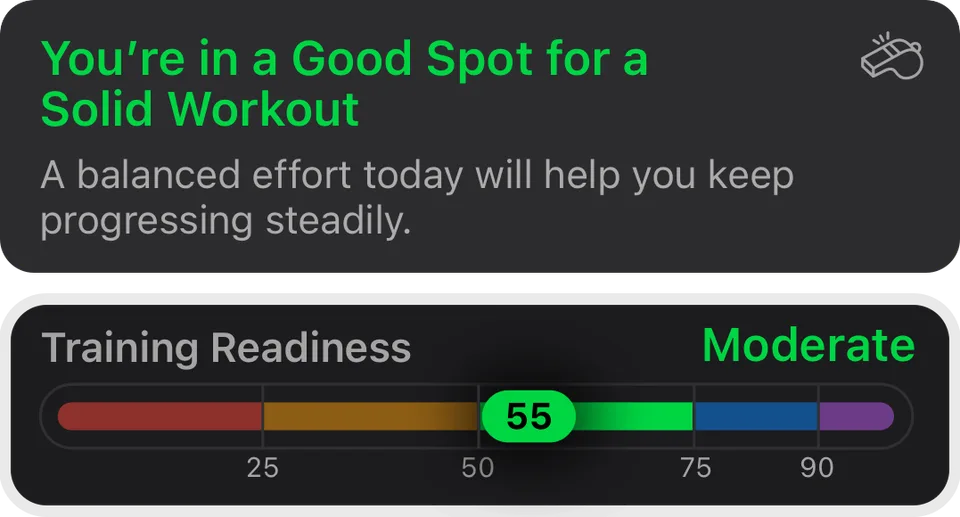
FITIV groups Training Readiness into five levels, each with a recommendation:
- 90-100 (Prime): "Your metrics are on point." Today is ideal for an intense session or a personal-best attempt, if you feel ready.
- 75-89 (High): "Time to challenge yourself." You're ready for a more intense session.
- 50-74 (Moderate): "You're in a good spot for a solid workout." A balanced effort keeps you progressing steadily.
- 25-49 (Low): "Focus on light activity." Low-intensity movement or stretching helps speed up recovery.
- 0-24 (Poor): "Your body needs rest." Take a recovery day and come back stronger.
Where You'll See Recovery and Readiness in FITIV
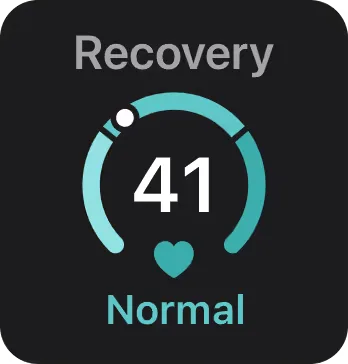
- Today tab: the Training Readiness bar shows today's score and level, a coaching card gives the day's recommendation, and the Recovery gauge sits next to Strain and Sleep. Tap Training Readiness or Recovery for its detail screen.
- Recovery detail: a 30-day chart with your 30-day best and average, plus a Contributors list showing last night's resting heart rate, HRV, respiratory rate, Sleep score, blood oxygen, and wrist temperature.
- Training Readiness detail: the same 30-day view, plus Training Readiness Impact, which shows how Recovery, Strain, Training Load, and Battery each affected today's score.
- Insights: on iPhone models with Apple Intelligence running iOS 26 or later, the AI Coach's Readiness Insights and Recovery Insights cards explain your day in plain language.
- Apple Watch and widgets: check Training Readiness and Recovery on your wrist or Home Screen without opening the app.
How FITIV Tracks Recovery
HRV as the Primary Recovery Signal
Heart rate variability is the most sensitive marker of recovery you can get without lab testing. Hard training suppresses parasympathetic activity, which lowers HRV, and as you recover, parasympathetic activity and HRV rebound.
Watch the trend more than any single reading. One low morning may come from a poor night's sleep, slight dehydration, or a measurement artifact. HRV that stays low alongside an elevated resting heart rate, poor sleep, or workouts that feel harder than usual is a much stronger sign of accumulated fatigue.
FITIV reads HRV automatically from the data your Apple Watch saves to Apple Health (using readings taken while you sleep by default), or from a Garmin or Fitbit you've connected under the More tab. Consistency matters here, because readings taken in different positions, at different times of day, or under different conditions add noise. Overnight readings avoid most of that without you having to remember a morning routine.
Sleep Score Integration
Sleep is your main recovery tool for both physical and neurological fatigue. During deep sleep, growth hormone release peaks, protein synthesis occurs, and the neural fatigue from hard training is cleared. Too little sleep, or poor-quality sleep, impairs recovery even when your training load is appropriate.
FITIV's Sleep score draws from the sleep data in Apple Health, usually recorded by your Apple Watch. It looks at time asleep against your personal sleep goal (7 hours by default, adjustable), sleep stages, sleep efficiency (time asleep versus time in bed), and heart rate dip (how far your heart rate drops from day to night). The Sleep score then feeds your Recovery score.
Resting Heart Rate Trend
An elevated resting heart rate (measured in the morning before rising) is a classic sign of incomplete recovery. Accumulated training stress activates the sympathetic nervous system, which raises baseline cardiac output and, with it, your resting HR.
A rise of 5 bpm or more above your personal baseline is considered significant. The clinical literature on overtraining consistently identifies elevated resting HR as an early indicator of non-functional overreaching, often appearing 1-2 weeks before subjective performance decline.
Recognizing and Avoiding Overtraining
Overtraining syndrome (OTS) is a clinical condition in which accumulated training stress exceeds your body's capacity to adapt, causing a drop in performance that persists despite adequate rest. Unlike normal fatigue, it typically takes weeks to months of reduced training to resolve. Functional overreaching, a milder and recoverable version, resolves with 1-2 weeks of rest.
FITIV's recovery tracking is designed to surface the early signs of overreaching before it sets in. Watch for:
- HRV below your typical range for several days in a row
- Resting HR above your typical range, which directly lowers your Recovery score
- Recent training load well above your usual load, which lowers Training Readiness
- Falling Sleep scores while training load is climbing
When these show up together, your Recovery and Training Readiness scores drop and FITIV's recommendation shifts toward light activity or rest. Read that alongside how you feel: when the scores and your own fatigue point the same way, back off. For everyday habits that help your score bounce back, see the help center's article on how to improve your recovery.
Using Recovery Data to Plan Training
Use your readiness score to decide how hard to train each day. High and Prime days are the time for hard sessions: intervals, threshold work, long efforts. Low and Poor days should be easy regardless of what your plan says. Say you had intervals planned for Thursday, but a late flight cut your sleep short and your Training Readiness comes in Low. Do an easy session instead and move the intervals to your next High day.
This approach, known as HRV-guided training, has research behind it. In controlled studies, athletes using HRV-guided training improved endurance fitness at least as much as athletes following a fixed plan (Manresa-Rocamora et al., 2021). The likely reason is timing: HRV-guided athletes did their hard sessions when they were actually recovered.
Why Recovery Tracking Matters for Athletes
Most athletes overtrain in one specific way: they don't make their easy days easy enough. When every session is moderately hard, the accumulated fatigue holds back both aerobic base development (which needs sustained Zone 1-2 work) and high-intensity adaptation (which needs full recovery before each hard session).
Progress comes from enough stress combined with enough recovery, and a daily score makes it easier to get that balance right.
Frequently Asked Questions
My recovery score is low but I feel fine. Should I still take it easy?
Use both signals. How you feel is a genuinely useful measure: a systematic review of 56 studies found that athletes' self-reported well-being tracked their training load more reliably than common objective measures (Saw et al., 2016). A single low score in isolation (when other signals are normal) is less concerning than a multi-day pattern of low scores. Because FITIV compares every reading to your own typical range, the score already reflects your personal normal rather than a population average.
How is FITIV's recovery score different from WHOOP's recovery score?
Both systems measure HRV, sleep, and resting heart rate and combine them into a recovery metric. WHOOP requires its own band and a WHOOP membership. FITIV works with the Apple Watch you already own. The underlying physiology is the same; the hardware flexibility and cost model differ.
Does recovery tracking account for non-training stress (work stress, travel, illness)?
FITIV tracks physiological signals that reflect total allostatic load, not just training stress. Work stress, travel, illness, and alcohol all affect HRV and resting HR in measurable ways. The recovery score will reflect these stressors even if no workout is logged.
How many days of data does FITIV need before recovery scores are reliable?
FITIV calculates a Recovery score from your first night of sleep data. Each vital is compared against your own typical range, so the score becomes more personal and more reliable the longer you wear your watch overnight.