
Running power is the rate of mechanical work you produce while you run, measured in watts (W) or in watts per kilogram of body weight (W/kg). Like cycling power, it gives you an instant read on intensity that terrain changes, wind, cardiac drift, and the delay while heart rate catches up don't distort. That's why more and more distance runners use it for pacing, setting training zones, and tracking performance.
How Running Power Is Measured
A running power meter estimates the forces your body produces and how quickly you apply them. It combines horizontal propulsive power, which overcomes air resistance and changes your speed, with vertical power, which works against gravity and the spring-like bounce of each stride. Modern meters pull together accelerometer, gyroscope, and barometric pressure data to estimate your total mechanical power in real time.
Cycling power is simpler. A bike power meter measures the torque applied to the pedals and multiplies it by angular velocity, a purely mechanical measurement with high accuracy and strong scientific consensus behind it. Running involves more complex biomechanics, so running power is currently estimated by algorithms rather than measured directly, and that introduces device-to-device variation. Running power values from different brands of meter aren't directly comparable.
Critical Power (CP) / Running FTP: The running counterpart to cycling FTP is usually called critical power: the highest power you can hold in a steady state, typically for somewhere around 30 to 60 minutes depending on the athlete. Some tools call it running FTP. It marks the line between running you can sustain and efforts that fatigue you quickly, and running power zones are set as percentages of it. In FITIV, you enter a running FTP by hand under More → Power → Running, separate from your cycling FTP.
Power-based running zones (one widely used five-zone model):
- Zone 1 (Easy): 65–80% of Critical Power
- Zone 2 (Moderate): 80–90% of Critical Power
- Zone 3 (Threshold): 90–100% of Critical Power
- Zone 4 (Interval): 100–115% of Critical Power
- Zone 5 (Repetition): 115–130% of Critical Power
FITIV uses seven running power zones instead, Zone 1 to Zone 7 as percentages of your running FTP, listed on that same Running screen.
Power's biggest advantage over pace is that it accounts for gradient automatically. Running uphill at 150W is the same physiological effort as running on flat ground at 150W. Your pace will differ, but power reflects the actual workload. Picture a Sunday run with a two-kilometer climb: hold your flat-ground pace up it and you're working far harder than you planned, while holding the same watts keeps the effort where you meant it to be. That makes power the ideal pacing tool for trail running, cross-country, and hilly road courses, where pace targets break down completely.
Some systems, notably Stryd, also report Form Power: the power spent on vertical oscillation (bouncing) instead of forward propulsion. Lower Form Power relative to total power means better running economy. Improving your form typically reduces it, so the same total power produces a faster speed.
Rough benchmarks at 5K race pace:
| Level | Typical Running Power (W/kg at 5K race pace) |
|---|---|
| Beginner (35+ min 5K) | Under ~2.5 W/kg |
| Recreational (25–35 min 5K) | ~2.5–3.5 W/kg |
| Trained (20–25 min 5K) | ~3.5–4.4 W/kg |
| Competitive (17–20 min 5K) | ~4.4–5.1 W/kg |
| Elite (sub-13 min 5K) | ~6.5+ W/kg |
These are rough values for flat ground, where running power in W/kg tracks closely with speed, so faster 5K times mean higher numbers. Devices calculate running power differently, so your own values may run higher or lower. Running W/kg isn't comparable to cycling W/kg.
How Running Power Relates to Training
Unlike heart rate, running power responds instantly when your effort changes. Hit a hill and power jumps straight away, while heart rate may take 30 seconds to a minute or more to catch up. That makes power valuable for even-effort pacing on variable terrain.
Power also lets you calculate TSS (Training Stress Score) for runs, the same metric used for cycling, so you can track training load across sports together. Running TSS is calculated identically to cycling TSS, with Critical Power substituting for FTP. In FITIV, a run with power gets a TSS based on the running FTP you set, shown on the workout's Training Load card.
Critical power, usually estimated from two or more maximal efforts of different lengths (for example, 3 and 9 minutes) or from your best recent efforts, gives you the personal threshold every running power zone is derived from. It mirrors FTP testing for cyclists.
Over months, the ratio of power to pace at standard intensities shows whether your running economy is improving. If you produce 250W at 5:00/km pace and later hold the same 250W at 4:50/km, your economy has improved: the same mechanical output now produces more speed, reflecting better biomechanical efficiency or a lower energy cost of running.
How FITIV Uses Running Power
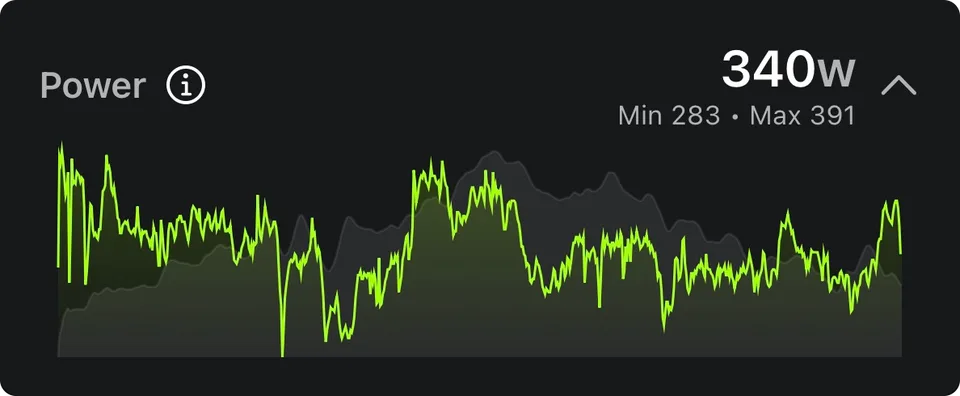
FITIV Pulse records running power from Apple Watch, which estimates it natively during runs. FITIV doesn't connect to Stryd or other running power foot pods directly. When you run with the FITIV Apple Watch app, you see:
- Real-time running power in watts, alongside pace and heart rate
- Average and maximum running power for the session
Your runs count toward the same short- and long-term training load as your rides and gym sessions, through TRIMP (heart rate) or TSS (power when available, or heart rate).
Frequently Asked Questions
Do I need a running power meter to use power-based training?
You need a device that measures it. Apple Watch estimates running power natively on watchOS 9 or later, with no extra hardware, and that's what FITIV uses. Dedicated foot pods such as Stryd, and some Garmin watches, also measure running power. FITIV doesn't connect to foot pods directly, so their full feature sets live in their own apps.
Are running power values comparable between different athletes or devices?
Running power values from different device manufacturers use different algorithms and are not directly comparable. A Stryd reading of 300W does not equal a Garmin running power reading of 300W: each is calibrated to its own algorithm. Within a single device, the values are internally consistent and perfectly useful for training purposes. This differs from cycling power, which is a direct physical measurement and is directly comparable across certified power meter brands.
Is running power better than pace for training?
Running power is better than pace for pacing on varied terrain (trails, hilly roads) because it accounts for gradient automatically. On flat, consistent surfaces, pace and power are closely correlated and both work well. Running power also responds faster than heart rate to effort changes, making it more useful for interval work. Many athletes use all three simultaneously: power for real-time effort control, pace for performance context, and heart rate for physiological state monitoring.
How is running power measured?
Running power is measured with foot pods (like Stryd) that use accelerometers to estimate the forces in each stride, or estimated from GPS speed, grade, and body weight. Apple Watch (watchOS 9 or later) and some Garmin watches also estimate running power from their built-in sensors.